

Detailed Guide
A step-by-step breakdown
Or read and review our submission tips below
This guide walks you through how to prepare and submit your story to the Royal Commission.
Every submission which shares a story about the impact of antisemitism in Australia is valuable, no matter how big or small. You can choose to make a submission anonymously or confidentially if you have concerns for your safety or privacy.
Submissions can be written in very basic English and don’t need legal language. This is simply about sharing the impact that the increase in antisemitism has had on you and the community.
Completing as much of the form as possible, with as much detail as possible, will help the Commission to identify issues and trends relating to antisemitism and social cohesion, and make recommendations to government.
Submissions close on 14 June 2026.
BEFORE YOU START YOUR SUBMISSION
Your submission must be made using the form at the Royal Commission’s official website: https://ascengagement.royalcommission.gov.au/submissions
The submission form must be completed and submitted in one sitting, or it will not be saved. The form will automatically shut down after 30 minutes of inactivity
Due to these limitations and to avoid losing your writing if the form closes suddenly, it is recommended you begin drafting your submission on an external platform (e.g. Microsoft Word, Google Docs, Notes etc.) to ensure you can complete your submission in your own words and in your own time.
If you refer to any attachments that you would like to submit, number each attachment and refer to it by number in your document. For example, file name: “Attachment 1” - inline text “I emailed NSW Police on 23 May 2025 (Attachment 1)”.
Note attachments that are not PDF, DOC or DOCX files will need to be sent separately to the Royal Commission. If you wish to remain anonymous and provide those attachments without identifying yourself, we may be able to assist you. You can access this support by contacting ShareYourStory.
Privacy Considerations
If you intend to make an anonymous submission, do not include your name or contact details in your submission document. If you intend to provide your name and contact details but do not want them to be published, you can make a confidential submission by choosing to not allow the Commission to publish your details when completing the submission form.
If you are content to be identified, but do not wish to give evidence at the Royal Commission, state clearly that you do not wish to be called to give evidence, and the reasons, so at the top of the document.
If you intend for your submission to be published by the Royal Commission, but think that names in your submission should be deleted from the submission before it does so, you should also expressly request this at the top of the document.
Also state at the top of the document if you are making the submission on behalf of any other person e.g. family members or a community organisation, and if so, identify each such person. You should only make a submission on behalf of someone else with their consent.
Accessing Support
Support is available if you found making your Submission caused you any distress. Visit the Royal Commission’s Support page for more information: https://asc.royalcommission.gov.au/counselling-and-support-services
THE SUBMISSION FORM
Section 1: Questions About You
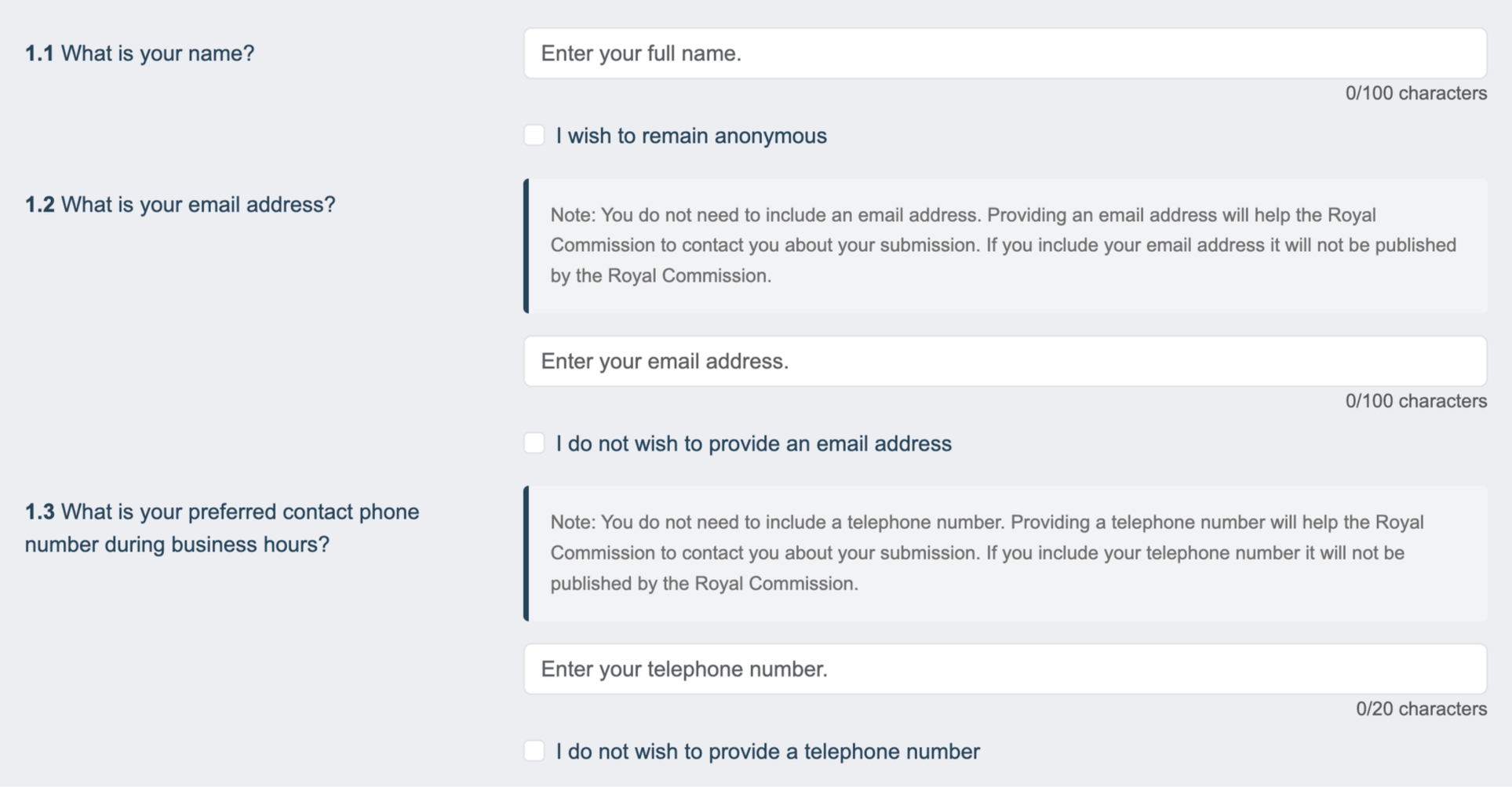
1.1– 1.3 Personal Details
Enter your personal details including full name, email, and phone number.
If you are making a submission on behalf of someone else, you should still include your own details here.
You have complete control over how your contact details are used. You can choose to:
Make a completely anonymous submission (by ticking the tick boxes at section 1.1-1.3)
The Royal Commission will not receive contact details that you elect not to supply – so it will not be able to contact you about your submission. Note that if you have attachments that need to be emailed, you will need to find a way to email them anonymously. We can help you with this.
Make a confidential submission by providing your details but request they do not get published (at Section 3 below)
The Royal Commission will know who you are but will not publish your details
Provide your details and agree to being contacted by the Commission if needed (at Section 3 below)
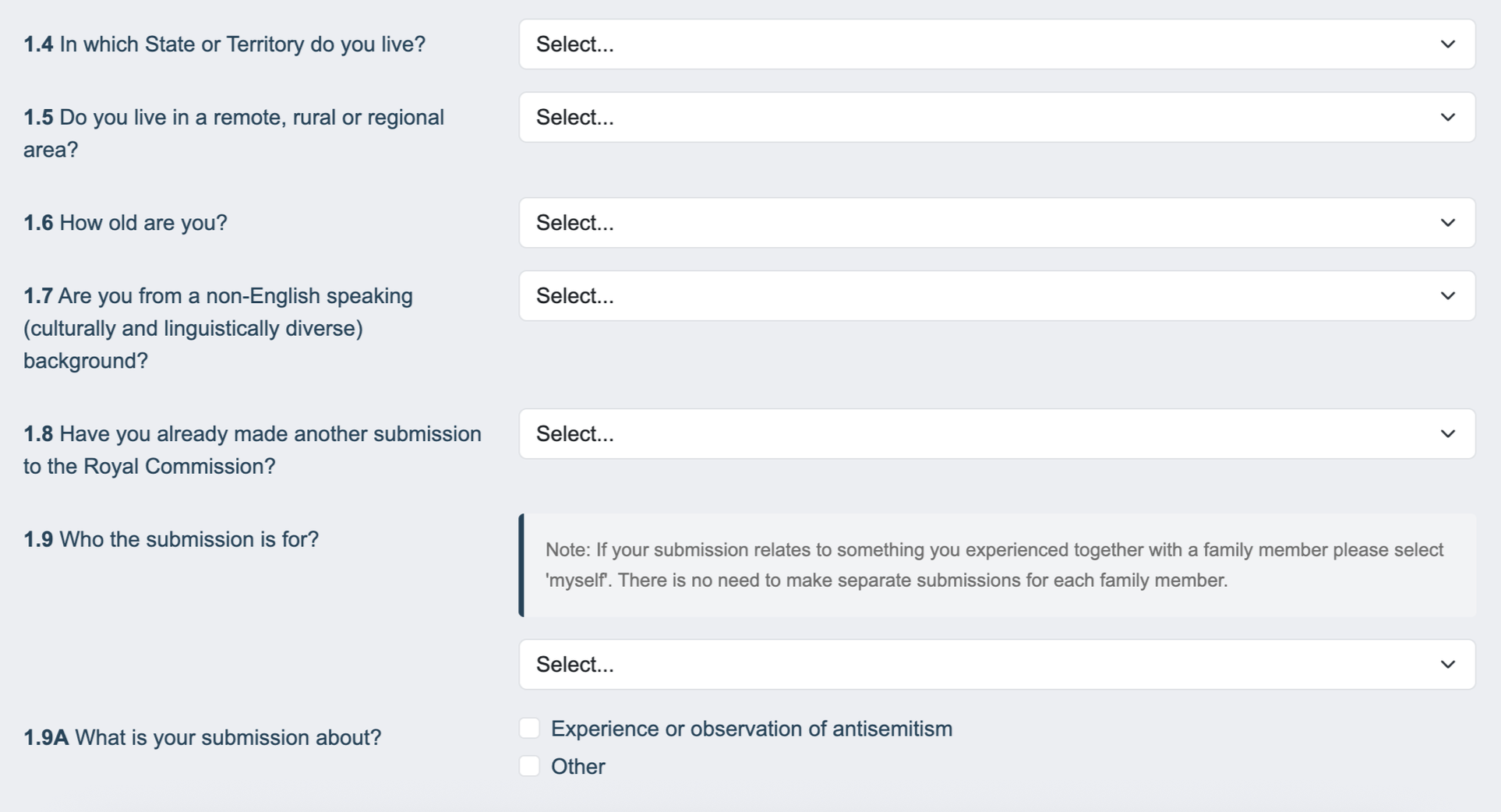
1.4 – 1.9 Demographic Details & Submission Background
These sections are generally mandatory. This information helps the Commission understand who is affected by antisemitism across Australia, your background, and your reporting history.
Details provided here will not be used to identify you personally.
Here is where you can provide:
The reference number of any previous submissions to the Royal Commission
Further details if you are making a submission on behalf of anyone other than yourself
Section 2: Your Submission
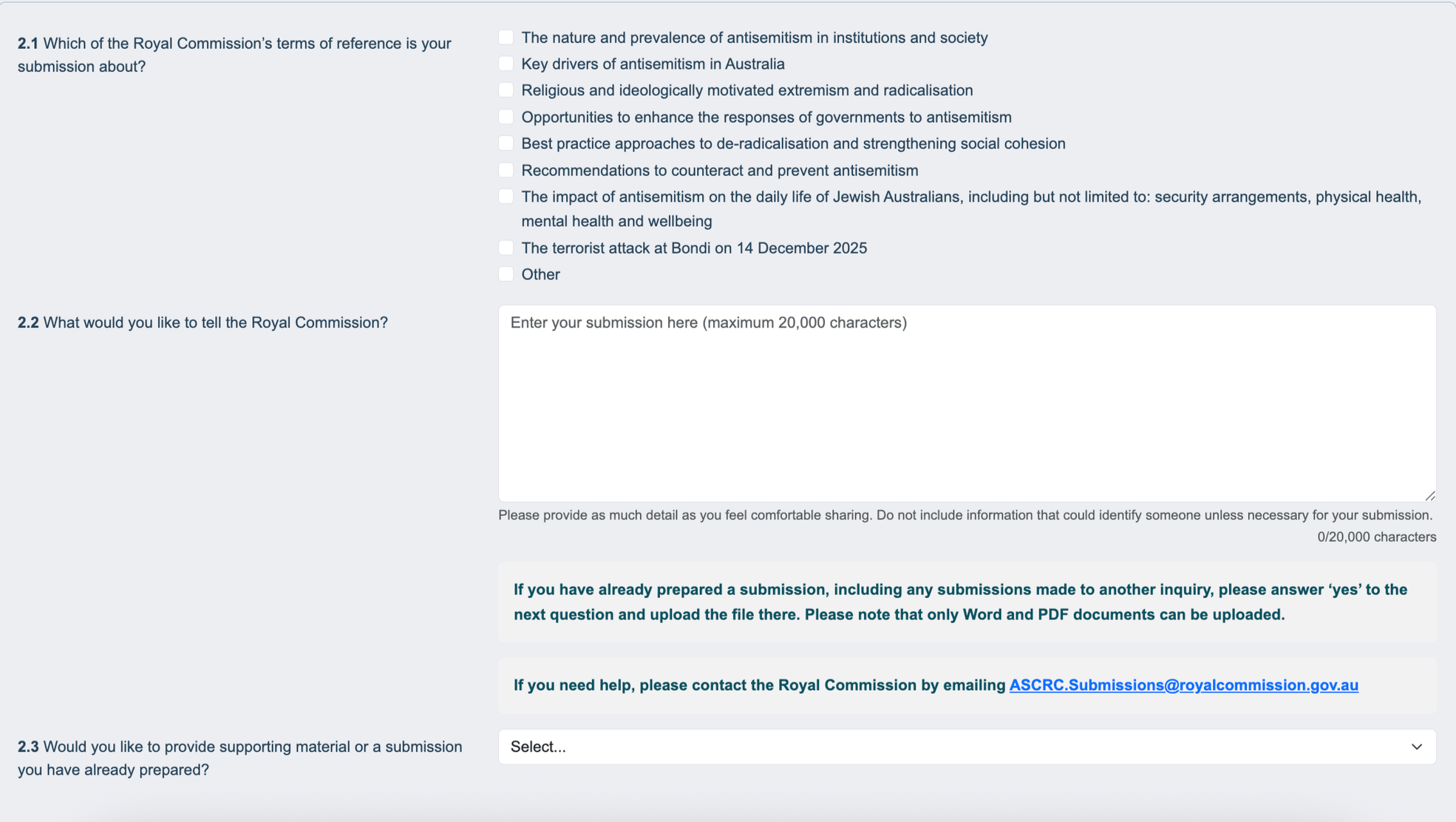
2.1 Terms of reference
This is where you will select the topics of the Royal Commission that you believe your submission is relevant to. You can select more than one.
Most people who share a personal story of antisemitism they have experienced or observed will most likely be able to at least choose either or both of:
“The nature and prevalence of antisemitism in institutions and society”
OR
“The impact if antisemitism on the daily life of Jewish Australians, including but not limited to security arrangements, physical health, mental health and wellbeing.”
If you choose ‘Other’ you may need to provide further information.
2.2 Submission
This is the main part of the form, and is where you will be able to share your story in your voice.
You can do this in two ways:
1. You can paste your pre-written submission or you can write directly into the textbox provided.
Your submission does not have to be a certain length but must be less than 20,000 characters. This is about 9 A4 pages of 12pt font. If you do this, keep a copy of what you copied into the text box for your records.
2. You can upload your electronic document in step 2.3.
In the textbox in step 2.2, type in “see attached” and in step 2.3, select “yes” and upload the file where indicated. Note the maximum upload size of 1GB.
2.3 Supporting materials
If you have supporting materials that you want to share, they can be uploaded in this section in either Word or PDF format.
This could include:
Copies of previous submissions to a separate inquiry
Emails, letters, screenshots, reports, or evidence of complaints
If you want to attach materials that are not in Word or PDF format such as image, video, or audio files, you will need to contact the Royal Commission directly by emailing ASCRC.Submissions@royalcommission.gov.au
Section 3: Publication and Use of Submission
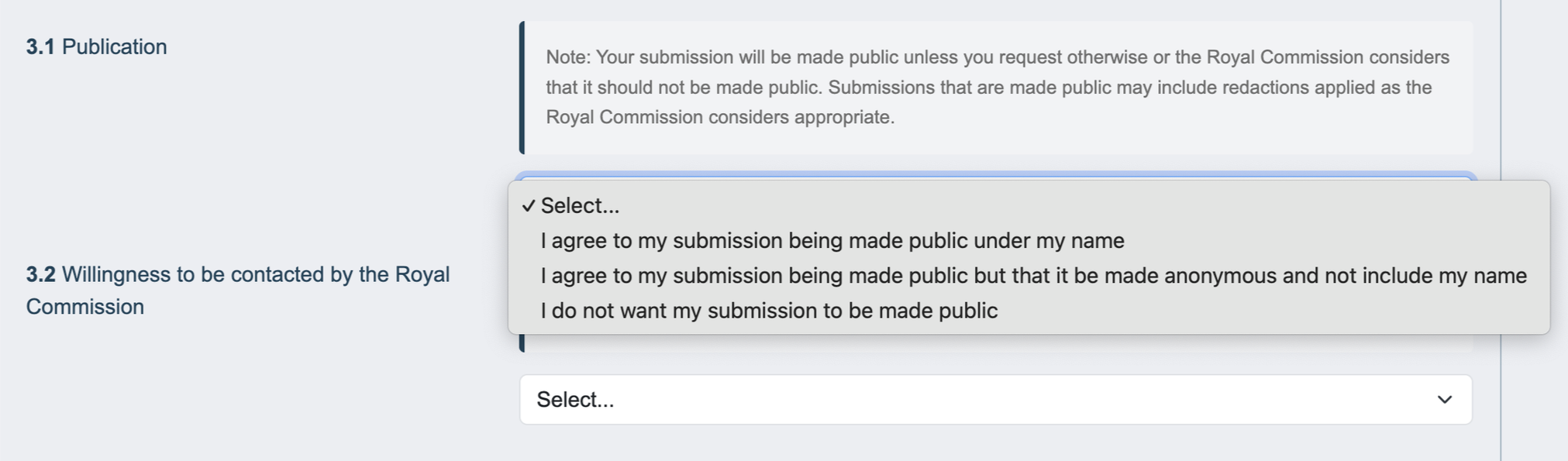
3.1 Publication preferences
Unless you choose otherwise, your Submission will be published by the Royal Commission.
In this section, you can agree or disagree to the Submission being made public, and whether your name can be published with it.
The Commission may remove some sections of your Submission if it believes necessary.
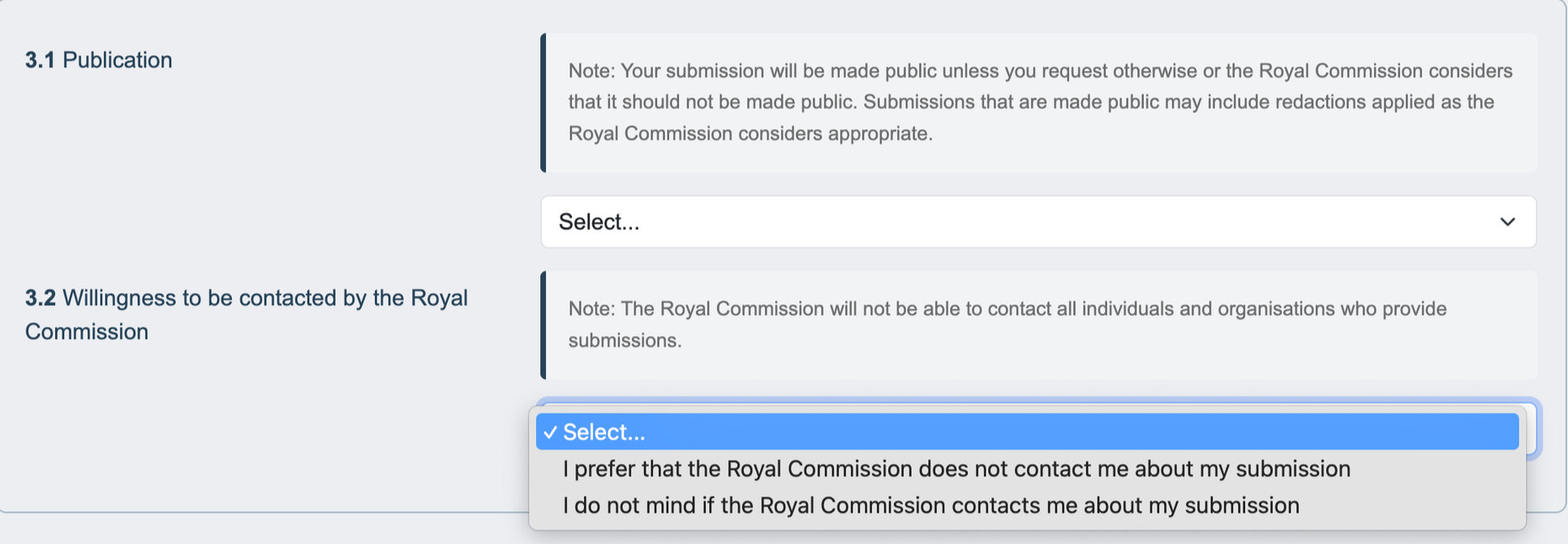
3.2 Contact preferences
The Royal Commission may need to contact you if they have questions about your submission. You can agree or disagree to being contacted.
If you do not provide your personal details in Section 1 of the submission form, the Commission will not be able to contact you even if you agree to being contacted in this section.
SUBMIT
Once all information is filled out and/or attached, you can click submit. This ends the submission process and sends your story to the Royal Commission.
You should retain a copy of your submission number and date as you will not receive an email confirmation of your submission.
AFTER-SUBMISSION: WHAT HAPPENS NOW?
The information you give to the Commission will be recorded, reviewed, and used to help the Commissioner and the inquiry. The Commission may contact some individuals or organisations to give evidence at a Hearing. Not everyone who makes a submission will be contacted or appear at a hearing.
The Royal Commission will be accepting submissions until at least the end of May 2026. The Commissioner is required to provide an interim report by 30 April 2026 and a final report before 14 December 2026.
If you are comfortable doing so, we would welcome you to provide us with a copy of the content of your submission that you submitted through the Royal Commission website. This will help us get a better understanding, and track the range, of issues being raised by members of the community with the Royal Commission.
Submissions shared with us may also be shared with the Executive Council of Australian Jewry (ECAJ) to assist their production of an Annual Antisemitism Report. This report helps them stay aware of the antisemitic conduct experienced by members of the community. Where appropriate, submissions shared to the ECAJ may also be shared on a confidential basis with the JCLJ or the team at Arnold Bloch Liebler. For information about ECAJ’s privacy policy and annual report, visit their website.
Encouraging others to share their story
Here is a message you can send to family, friends, colleagues and non-Jewish allies to encourage them to make Submissions too:
Hi [insert name]. I’ve just finished sending my Submission to the Royal Commission on Antisemitism and Social Cohesion. If you have been thinking about doing one, you really should. It’s pretty quick, and the more people who speak up, the better.
Thank you for sharing your story.