
Royal Commission on Antisemitism and Social Cohesion
Your story deserves to be heard.
This is Australia’s first Royal Commission on antisemitism - what we share will shape Australia’s future. The Commission can only act on what it hears. Without your story, nothing changes.
This opportunity won’t come again. Make it count.
Submissions close 14 June 2026.
Ready to share your story? Visit the Royal Commission website to make a submission.
Want to learn more? Read our how-to guide to see how the submission process works.
Public Hearing Block 1 is now complete. We are grateful for those who stepped into the witness box and shared their stories.
Click below to see our full summary.
Summary of Hearing Block 1
||
Summary of Hearing Block 1 ||
“What I experienced wasn’t dramatic — but it was real, and it mattered. Sharing it felt like reclaiming something.”
Making A Submission
A How-To Guide
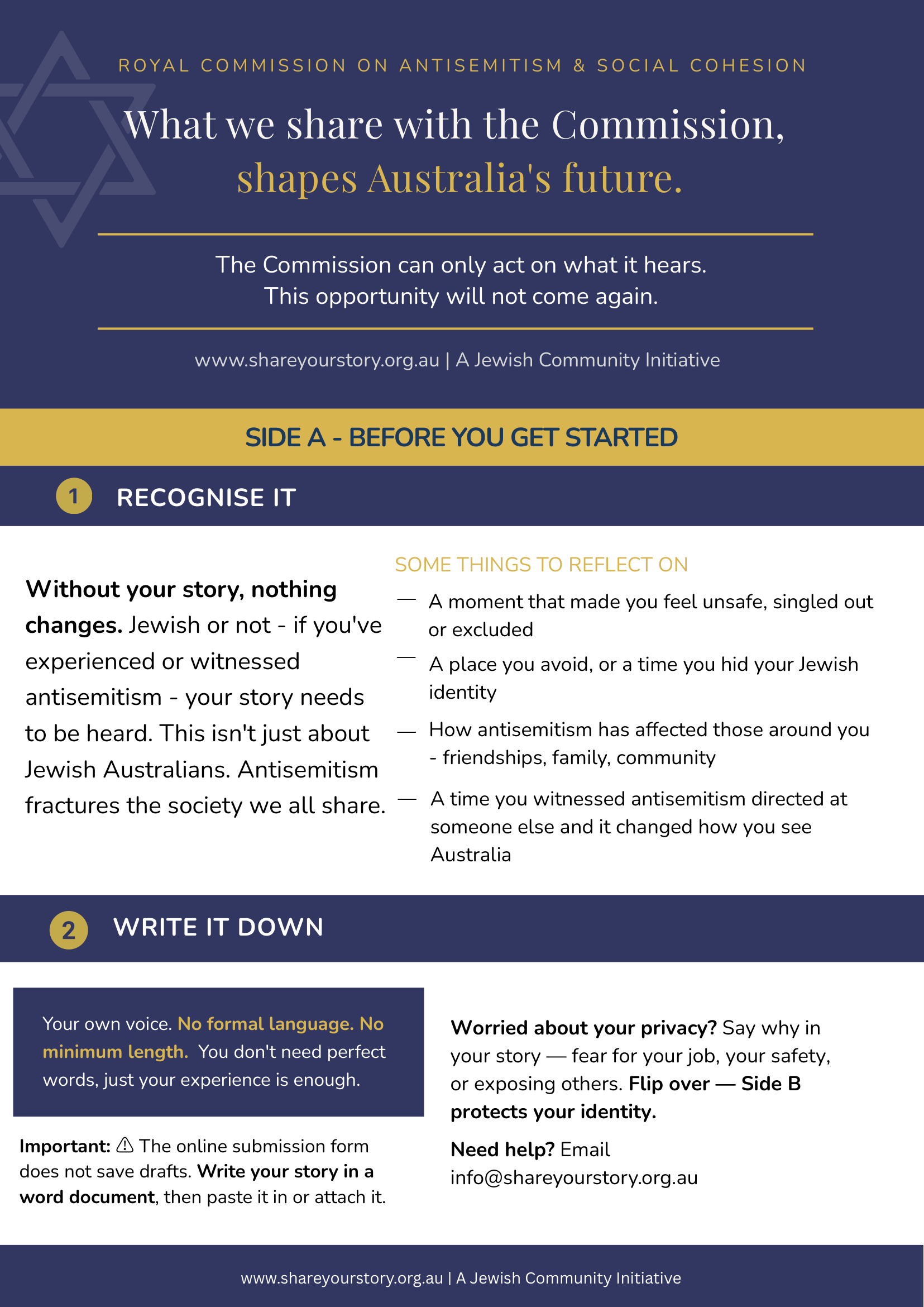
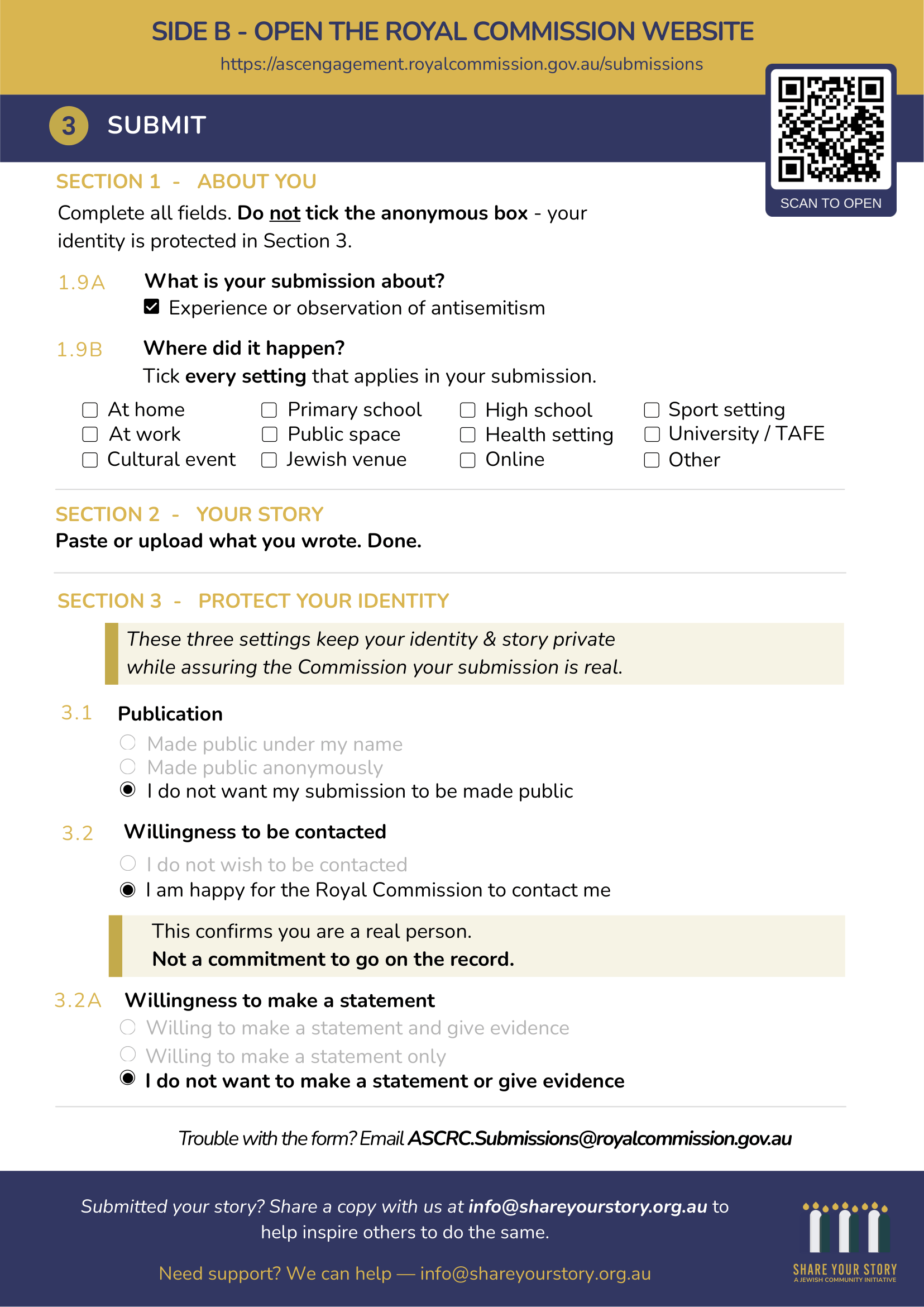
This simple guide outlines exactly what you need to do throughout the submission process. A downloadable and print-ready PDF is readily available for you to use and share.
How it works
Without your story, nothing changes. Jewish or not - if you've experienced or witnessed antisemitism - your story needs to be heard.
This isn't just about Jewish Australians. Antisemitism fractures the society we all share.
Three steps to making your submission
01
Recognise it
There's no minimum - a single incident, a pattern over time, or your broader sense of safety all count. You can use our prompts below to help you reflect on your experiences.
02
Write it down
Your own voice. No formal language. No minimum length. You don't need perfect words, just your experience is enough. You can attach supporting material if you have it. Write it in a Word document - the form will time out if you type it in directly.
03
Submit
Submissions are made online via the Commission's own website. If you have any concerns first - legal, safety, or otherwise - we can help. Submit Now. Make sure you record your reference number - the Commission will not send a confirmation email.
Ready to share your story?
Visit the Royal Commission website to make a submission.
Public Hearing Block 1
From 4 to 14 May 2026, the Royal Commission on Antisemitism and Social Cohesion held its first block of public hearings in Sydney. Over eight days, more than fifty witnesses stepped forward to give evidence.
We are deeply grateful to every person who had the courage to do so.
4-15 May 2026, Sydney
Public Hearing Block 2
From 25 May in Sydney, the Commission will host its second block of public hearings. This block will examine the circumstances surrounding the attack at Bondi on 14 December 2025, with a particular focus on terrorism threat level and security environment in the lead up.
Matters identified in the Royal Commission’s Interim Report (released 30 April 2026) will also be examined as needed.
Tune in to the live hearings from 25 May 2026: https://asc.royalcommission.gov.au/
Submissions are open until 14 June 2026. The Commission can only act on what it hears. Your own voice. No formal language. No minimum length. You don't need perfect words. Your experience is enough.
From 25 May 2026, Sydney
What to include
Not sure where to start?
These prompts have helped others begin. You don’t need to address all of them; you can start with whichever feels most important.
When did it happen? It might be a particular incident, a moment or an experience that has stayed with you, even years later.

Where did you experience or witness antisemitism - was it at school, university, in a public place, the workplace or even online spaces? You can talk about multiple experiences in the same submission.

Words, behaviours or actions that made you feel unsafe, singled out, or excluded as a Jewish person.

Times when someone spoke up — or stayed silent — when it mattered.

Did you raise the incident with anyone or make a complaint? Did institutions or systems respond well, or did they make it worse?

How your sense of safety and belonging in Australia has changed over time.

How did it impact on you, your family or broader community.

Supporting documents — emails, screenshots, complaints — can be attached.
Your submission does not need to focus on a single event. For many people, experiences are not one moment, but a series of interactions, patterns, or everyday situations that have shaped how they move through the world.
These might include changes in behaviour, feeling the need to be more cautious, discomfort expressing identity or beliefs, or experiences in workplaces, schools, public spaces or online environments.
Experiences that may seem minor on their own can still be important. If something has made you pause, feel uncomfortable, or influenced how you act or make decisions, it may be worth including.
Know someone who should submit? Encourage friends and family to submit.
The most powerful submissions come from people who were encouraged by someone they trust. If you've already submitted — or if you know someone carrying a story they haven't shared — pass this on.
Community Voices
People like you have already submitted. Their accounts span careers, campuses, schools and everyday life. No two are the same - and none were required to be perfect.
If you’re comfortable doing so, please share your submission with us. This will help us get a better understanding and track the range of issues being raised by members of the community with the Royal Commission. All materials will be de-identified.
Help us gain a better understanding and track the range of issues members of the community are raising with the Royal Commission.
Submissions shared with us may also be shared with the Executive Council of Australian Jewry (ECAJ) to assist their production of an Annual Antisemitism Report. These reports record antisemitic incidents and discourse over a 12-month period ending 30 September each year.
By sharing your submissions with us, we can ensure there is no lost incident / discourse data and maximise our community’s ability to identify trends, themes, and possible solutions to antisemitism.
We will always ask for your permission to share your submission with the Executive Council of Australian Jewry. If you choose to share your submission with us, you can request for it to remain anonymous or confidential.
For more information about the Executive Council of Australian Jewry’s annual report, please visit its website.
If you've experienced antisemitism, witnessed it, or seen how it's been handled — or mishandled — your account belongs in this record.
You may wish to make a submission if you have:
seen antisemitism in a school, university, workplace or public setting, including online
supported someone who has been affected or been involved in responding to an incident
experienced impacts in a business or local setting, including concerns around safety or staff wellbeing
worked in education, healthcare, policy, community services or another relevant field
observed patterns or shifts in behaviour, language or attitudes
A clear account of what you have seen, heard or experienced, in your own words, is valuable.
Understanding antisemitism in Australia depends on a wide range of experiences and perspectives. Contributions from across the community help build a clearer picture of how it is recognised, understood and addressed, and what it means for social cohesion.
-
You can provide your details but ask that your identity is not made public.
This allows you to share your experience openly while keeping your name private. The Commission will know who you are and can contact you if needed, but your identity will not be published.
If you choose this option, you may wish to share why you would like your identity protected. This can help the Commission understand how your experience affects you in everyday life, including any concerns around safety, reputation, or your professional circumstances.
Your submission may still be used by the Commission, in a de-identified form.
-
You can choose whether your submission is published.
This is separate from whether you share your name.
If you submit confidentially, your name will not be published, but your submission can still be shared without identifying you.
If you do not agree to publication, your submission will not be published.
-
You can indicate whether the Commission may contact you.
Providing contact details allows the Commission to follow up if it needs to better understand your submission. Being contactable can help ensure your experience is fully understood.
If you do not provide contact details, the Commission will not be able to reach you, even if you indicate that it may.
-
You can choose not to provide your name or contact details.
The Commission will still review your submission, but it will not be able to contact you to clarify information or verify details if needed.
-
Making a submission means you may be contacted by the Commission, and in some cases, invited to give evidence.
Not everyone who makes a submission will be contacted or asked to appear at a hearing.
If you are invited to give evidence, this may take place in a private setting or at a public hearing. You can indicate your preference, and the Commission will take this into account, including your safety and wellbeing, the sensitivity of the material, and the risk of identifying individuals. The final decision rests with the Commission.
If you are asked to participate, support may be available to help you through the process.
Your privacy and identity choices
Support & Resources
You don't have to do this alone. Depending on what you need, there are different kinds of support available.
If you're unsure about any part of the process, or want guidance before you start, reach out and we'll help point you in the right direction.
General Questions
The Jewish Centre for Law & Justice is assembling a team to review submissions from eligible individuals. If you have concerns about confidentiality or liability, legal advice is available.
Legal Support
We've prepared both a quick guide and a more detailed walkthrough to help you structure your submission at whatever level of depth feels right.
Submission Guides
Understand what the Royal Commission is, what it's examining, who can submit, and what happens with your submission once it's received.
About the Commission
Recounting antisemitism can mean visiting moments that were confronting or painful. If you need to talk to someone, contact Jewish Care. Well-being and emotional support are available.
Emotional Support
About
Built for the community, by the community
ShareYourStory was created so that every Australian — regardless of how “significant” their experience may feel — has the tools and confidence to participate in this historic process.
Recounting antisemitism can mean revisiting moments that were confronting or painful. We’ve designed this site to be clear, supportive and accessible at every step. Community support is available is here.
This site will continue to add resources and information as the Commission progresses.
Get involved
Go further than a submission.
Volunteer as a community voice
If you've already submitted and are willing to share your experience publicly— in media, community forums, or on this site — we' d like to hear from you.
Help within your community
Running a shul, school, organisation or community group? We can provide materials and support to help your community engage with the Commission.
Get in touch
Support community engagement with the Commission
We need to support as many Australians as possible to share their story with the Commission. If you would like to be part of our community engagement strategy and support others in speaking up, reach out so we can get you involved.
Submissions close on 14 June 2026.
Your story — however you choose to tell it — is part of the evidence that shapes what happens next.